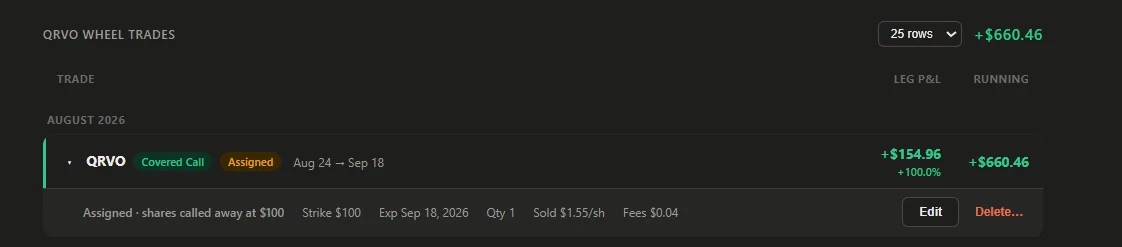
100 shares bought outright and covered the same day. One call, left alone for 25 days until the shares were called away.
This is one completed wheel from Tim’s own account, chosen as a worked example. It is not a record of all of his trades, it is not a typical or expected result, and it is not a recommendation to buy, sell, or write options on any stock. Every figure below comes from his OptionsLoop trade log.
On August 24, 2026, Tim bought 100 shares of Qorvo (ticker QRVO) at $94.95 a share, a $9,494.50 position. The same day he sold one covered call against them: a $100 strike expiring September 18, 2026, for $1.55 a share. That is $155.00 of premium, or $154.96 after a $0.04 fee.
Selling a call on the same day the shares are bought is often called a buy-write. Like the Unity case study, it started with shares owned outright rather than with a cash-secured put, so it is the covered-call half of the wheel on its own. See Cash-Secured Puts vs. Covered Calls.
The call was never closed or rolled. It ran to expiration on September 18, was assigned, and the 100 shares were called away at the $100.00 strike, 25 days after they were bought. The call kept 100% of its premium, and the shares sold for $505.50 more than they cost.

| Covered-call premium, after fees | +$154.96 |
|---|---|
| Stock gain (100 shares, $94.95 to $100.00, no fees recorded) | +$505.50 |
| Wheel total | +$660.46 |
| Capital in the shares | $9,494.50 |
| Return on that capital, over 25 days | about 7.0% |
| Cost per share after the call premium | about $93.40 |
| Premium as a share of the stock gain | about 31% |
Here the stock did most of the work. It rose 5.3% while the single call's premium came to 1.6% of the capital. Annualizing a 25-day result would produce a number too large to take seriously, so this page does not. See Annualized Return on Options Premium.
A $100 call against shares bought at $94.95, sold for $1.55, has a ceiling. The most it can pay is the $505.50 gain from cost to strike plus the $155.00 of premium, $660.50 before fees. After the $0.04 fee that is $660.46, exactly what this wheel made. Being assigned at the strike meant the position earned everything it could have earned, and also that any rise above $100 was given up.
The same structure protects very little on the way down. The $1.55 of premium lowered the cost to about $93.40 a share, a cushion of 1.6%. Had QRVO fallen well below that, the shares would have carried a loss the premium could not cover. See Running the Wheel in a Down Market.
Tim ran two very different wheels on shares he owned outright. QRVO was one call left alone; Unity was six rounds of short-dated calls bought back early.
| QRVO | Unity (U) | |
|---|---|---|
| Shares | 100 | 200 |
| Capital in the shares | $9,494.50 | $8,843.00 |
| Days held | 25 | 44 |
| Call trades | 1 | 10 (six rounds) |
| Call premium, after fees | +$154.96 | +$697.07 |
| Premium as a share of capital | 1.6% | 7.9% |
| Stock gain | +$505.50 (5.3%) | +$156.81 (1.8%) |
| Wheel total | +$660.46 | +$853.88 |
| Return on capital | about 7.0% | about 9.7% |
In QRVO the stock rose 5.3% and the premium was the smaller part of the result. In Unity the stock rose 1.8% and the repeated calls earned most of it. The wheel’s return comes from two sources, the shares and the premium, and the mix depends on what the stock does. Neither result predicts the next one, and two examples are not enough to say which approach is better.
OptionsLoop links each call to the shares it was written against, so a wheel’s cost basis, leg-by-leg results, and total show up in one place instead of a pile of separate trade rows.
Try OptionsLoop freeFor educational purposes only, not financial advice, and not tax or legal advice. This case study reports real trades from one account. Past results do not predict future results, and this wheel is not representative of all results. Options trading involves substantial risk, including the potential loss of your entire investment. OptionsLoop is a tracking tool, not a broker or investment adviser, and does not recommend specific securities or strategies.